
About this product
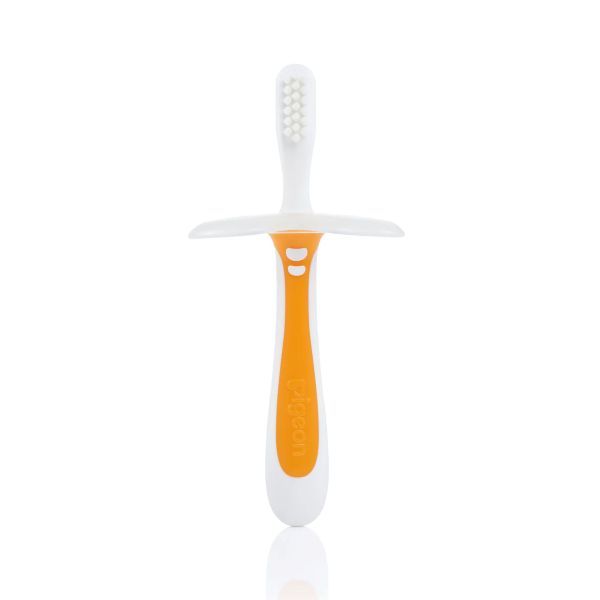
Pigeon Training Toothbrush Step 2
Little hands, little teeth and the beginnings of a big daily habit.
The Pigeon Training Toothbrush Step 2 is designed to help babies and toddlers become familiar with the movements and sensations of toothbrushing.
With a soft elastomer brushing head, fine flexible bristles and a wide, easy-to-grasp handle, it gives little ones an opportunity to explore brushing their new teeth while being gentle on tender gums.
The included safety shield helps limit how far the brush can enter the mouth, making it a thoughtful design for supervised early brushing practice.
It’s a lovely next step for little ones who are beginning to move beyond simply mouthing a toothbrush and are ready to explore what brushing actually involves.
Why we love it
Toothbrushing is a surprisingly complex skill for a little person.
There’s the feeling of the brush in the mouth, the movement across the teeth and gums, the coordination needed to hold and position it, as well as the experience of having someone else help clean their teeth.
We like that Pigeon’s Step 2 brush makes room for children to participate in that process.
The soft elastomer head introduces a gentle brushing sensation, while the chunky handle is designed for little hands that are still developing their grasp and control.
And the safety shield is a useful feature during supervised exploration, helping limit how far the brush can be inserted into the mouth.
Great for
- Babies and toddlers learning about toothbrushing
- Early toothbrushing routines
- Exploring brushing movements
- Little ones with newly emerging teeth
- Gentle contact with tender gums
- Becoming familiar with bristle-like sensations in the mouth
- Practising holding and moving a toothbrush
- Encouraging participation in daily oral care
- Transitioning from mouthing a training brush towards purposeful brushing
- Caregiver-supported brushing practice
Soft bristles for new little teeth
The Step 2 brush features a soft elastomer head with fine, flexible bristle ends.
These are designed to make gentle contact with emerging teeth and gums, including around the small spaces between teeth.
For a child who is just beginning to explore brushing, the softer material provides a different experience from a conventional toothbrush with firmer bristles.
It’s an opportunity to become familiar with the feeling of a brush moving over the teeth, without expecting them to manage the entire brushing routine independently.
A handle made for little hands
The wide handle is designed to be easier for small hands to grasp.
That matters because early toothbrushing involves more than simply accepting a brush in the mouth.
Children are also learning how to hold it, move it, change its position and coordinate their hand movements with what they’re feeling inside their mouth.
They may initially chew on the brush, turn it around or make only a few brushing movements.
With gentle encouragement and repeated opportunities, they can gradually become more involved in the routine.
What does the safety shield do?
The included safety shield attaches to the toothbrush and is designed to help limit how far the brush can enter the mouth.
This is particularly useful when little ones are still learning to control their hand movements.
The shield is an added safety feature, not a substitute for adult supervision. Babies and toddlers should always be closely supervised when using a toothbrush.
A feeding therapist’s note
I often remind families that toothbrushing involves both sensory learning and motor learning.
A child needs to become familiar with how the brush feels against their lips, tongue, gums and teeth. They’re also learning what to do with their hands and how brushing movements work.
I like training brushes that give children a chance to take part rather than having toothbrushing be something that only happens to them.
That might mean letting them hold the brush, explore the soft head or practise a few little movements before a parent takes over to finish cleaning their teeth.
I wouldn’t expect a young child to brush thoroughly on their own and I wouldn’t insist that they tolerate lots of brushing practice if they’re becoming distressed.
Short, positive opportunities to participate can be a helpful part of building familiarity with the routine.
The goal is not perfect brushing technique at this stage. It’s learning to participate in oral care while still getting the help they need to keep their teeth clean.
Product details
- Step 2 training toothbrush
- Soft elastomer rubber brushing head
- Fine, flexible bristle ends
- Designed for emerging baby teeth and tender gums
- Wide, easy-to-grasp handle
- Includes safety shield attachment
- Safety shield helps limit insertion depth
- Designed to introduce early brushing movements
- Part of Pigeon’s staged training toothbrush range
- By Pigeon
Important
Always supervise babies and young children when using a training toothbrush. Ensure the safety shield is correctly attached according to the manufacturer’s instructions.
The safety shield helps limit insertion depth but does not eliminate the risk of injury or choking.
Inspect the toothbrush regularly and replace it if the head, bristles, handle or shield show signs of damage or wear.
Training toothbrushes do not replace thorough caregiver-assisted toothbrushing. Teeth should be cleaned from the time the first tooth appears, using age-appropriate brushing guidance and toothpaste recommendations from your child’s dental health professional.
Shipping & returns
We send Australia-wide. Delivery costs and timings, and how to arrange a return, are set out on our shipping & returns page.
If something isn’t right for you, get in touch and we’ll sort it out.
You might also like


Ark Therapeutic
z-vibe bite tube
ARFID & Restrictive Eating Chewing Practice


Ark Therapeutic
z-vibe brick tip
Chewing Practice Mealtime Regulation
We are happy to talk it through.
If you are weighing up two options, or you are not sure this is the right fit, send us a note. We would rather help you choose well than sell you the wrong thing.